Wellness Without Technology: Why Simple Still Wins
Cryo pods and hyperbaric chambers promise a nervous system reset. Here's what the research really shows and the five simple things that matter more.
Shanti-Som Wellness Team
22 september 2026
There's a particular kind of tiredness that no amount of equipment seems to fix.
You know the one. You've been sleeping badly for months, you're snappy with people you love, and somewhere between the third coffee and the evening scroll you've started wondering whether your body is quietly filing a complaint. So you look for answers — and the answers now come with price tags, membership tiers and a chamber you climb inside.
Wellness without technology has started to sound almost quaint. The industry hit a record $6.8 trillion in 2025, according to the Global Wellness Institute, and a growing slice of that is hardware. Cryotherapy chambers. Hyperbaric oxygen. Red light panels, cold plunge tanks, full-body scanners.
Here's the thing worth sitting with before you book any of it: the evidence for the machines is thinner than the marketing suggests, and the evidence for the unglamorous stuff — sleep, movement, food, nature, people — is remarkably solid. Understanding that difference isn't about being a wellness cynic. It's about where you put your limited money, your limited hours and your limited energy.
What we mean by "clinical wellness"
Clinical wellness is the aesthetic as much as the equipment. White rooms. Recessed lighting. A menu of treatments priced per session. Screens showing your metrics back to you.
It's worth separating two things that often get bundled together. A nervous system reset is the shift from your body's stress response — alert, braced, running on cortisol, the body's main stress hormone — into its rest-and-recovery state, where digestion, repair and deep sleep happen properly. That shift is real and it matters.
Recovery technology is one proposed route to it. Just not the only one, and, as it turns out, not the best-evidenced one.
What the research actually shows
Let's take the two treatments that come up most.
Whole-body cryotherapy. A Cochrane review — Cochrane reviews are the gold standard for weighing up medical evidence — looked at the trials on cryotherapy for muscle soreness after exercise. It found four studies. Sixty-four participants in total, nearly all young men. The reviewers graded the evidence "very low quality" across every outcome and concluded there's "insufficient evidence to determine whether whole-body cryotherapy reduces self-reported muscle soreness, or improves subjective recovery, after exercise." For several results, the statistics couldn't rule out that doing nothing worked just as well.
That's not a claim that cryotherapy does nothing. It's a claim that we don't yet know — which is a very different proposition to the one on the price list.
Hyperbaric oxygen therapy. HBOT is genuinely effective for a specific set of conditions: hard-to-heal wounds like diabetic foot ulcers, carbon monoxide poisoning, decompression sickness, severe burns. Harvard Health sets that out clearly — and is equally clear that some facilities market it for conditions where "the FDA has not cleared or approved" its use.
General fatigue and stress aren't on the approved list.
Now the part the brochures are quieter about.
Whole-body cryotherapy sessions are typically a recurring expense, with providers often recommending multiple sessions a week for sustained results — potentially adding up to a significant ongoing commitment over time.
Clinical HBOT sessions can last 90 minutes to two hours, with standard protocols often involving five sessions a week over several weeks. A full course can mean dozens of hours in a chamber before you factor in travel, parking and the rest of your day.
Cash-pay HBOT can also represent a substantial per-session expense. Home chambers require a significant upfront investment, with costs varying widely depending on the type and specifications of the equipment.
At the top end, longevity clinics offering bundled diagnostics, therapies and ongoing programmes can involve a substantial annual financial commitment.
Stack a couple of these protocols together and you're looking at four, five, six appointments a week. For most people — a job, a commute, children, ageing parents, a life — that's not a wellness routine. It's a second job that you pay to attend.
And there's a quiet irony in it. The pursuit of calm becomes another thing in the diary. Another thing to be late for.
Let's be fair to the machines
This isn't to say technology has no place. Some of it can be genuinely useful — for example, you can explore hot and cold therapy without necessarily having to commit to an ice bath.
Two things can be true at once. A treatment can be enjoyable, well-tolerated and worth the investment for someone, while still not being the most sensible place to start compared with getting the fundamentals right, like sleep.
Ultimately, health is personal. What makes sense depends on your time, your finances, your goals and the particular concerns you're trying to address.
The five things the evidence keeps returning to
At our retreats we've built everything around five pillars: movement, nutrition, sleep, nature and connection. Not because they sound nice on a website, but because the research behind them is older, larger and far more consistent than anything supporting the hardware.
Movement. The WHO guidelines recommend 150–300 minutes of moderate activity a week for adults, with muscle-strengthening work on two or more days. That's a walk most days and a couple of strength sessions. No membership required.
Nutrition. The republished PREDIMED trial in the New England Journal of Medicine found that people assigned a Mediterranean diet supplemented with extra-virgin olive oil or nuts had roughly a 30% lower rate of major cardiovascular events than the control group. Vegetables, olive oil, fish, pulses, nuts. Food you'd actually want to eat.
Sleep. The American Academy of Sleep Medicine and the Sleep Research Society put the figure at seven or more hours a night for adults, on a regular basis, to support health. Seven hours. It's free, and most of us are quietly robbing ourselves of it.
Nature. A large study of nearly 20,000 people in Scientific Reports found that spending at least 120 minutes a week in natural settings was associated with significantly better self-reported health and wellbeing. Two hours. Spread however you like across the week.
Connection. A landmark meta-analysis in PLoS Medicine, pooling 148 studies and more than 300,000 participants, found that people with stronger social relationships had a 50% greater likelihood of survival over the follow-up period. The authors put the effect on a par with well-established risk factors like smoking.
Read those back and notice something. Not one of them needs a device. Every one of them needs time, attention and — this is the difficult part — permission to stop.
The part almost everyone forgets: the room you're in
Here's where it gets interesting, because your environment is doing something to your nervous system whether you've thought about it or not.
In a study published in Science, Roger Ulrich found that surgical patients in rooms with a window view of trees had shorter post-operative stays and needed fewer strong painkillers than matched patients facing a brick wall. Same hospital. Same surgery. Different view.
Light does its own quiet work. Research in the Journal of Clinical Endocrinology and Metabolism showed that ordinary room light in the hours before bed suppressed melatonin — the hormone that signals night to your body — by around 71% compared with dim light, and shortened its duration by roughly 90 minutes.
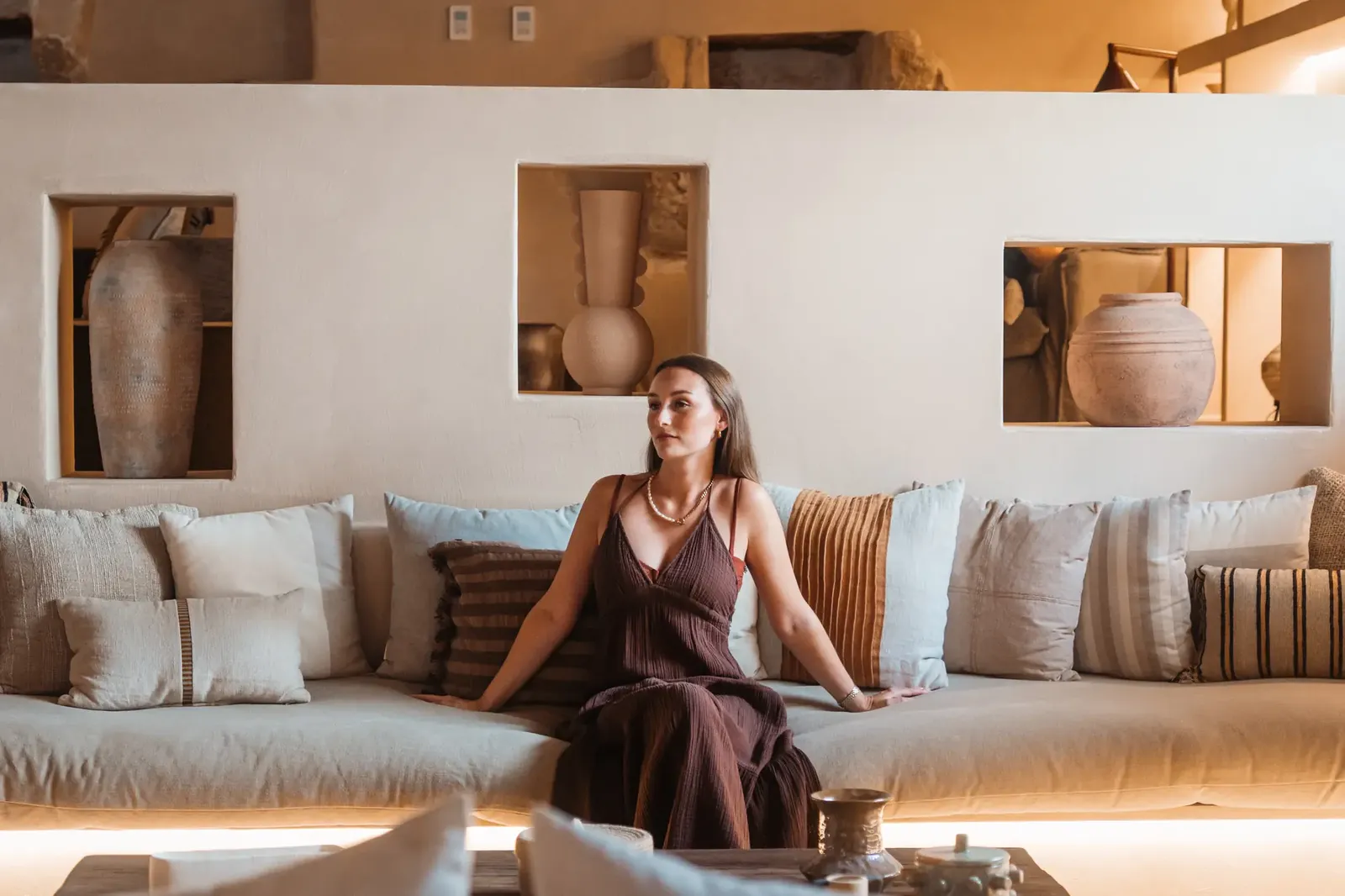
So when we design our spaces, this is the thinking behind it. Warm, comfortable interiors rather than white and sterile. Furniture placed so people end up in conversation instead of side by side in silence. Natural textures. Soft lighting in the evening. Places you can genuinely settle into, which is a harder thing to build than it sounds.
Not another clinical wellness environment. Not another beige canvas.
Why a retreat can help
If the five pillars were easy to do at home, you'd have done them already.
That's the honest case for stepping away. What a stay offers isn't a technology you can't buy — it's the one thing your ordinary week refuses to give you, which is uninterrupted space. Meals arrive and they're already the right meals. Movement is in the day, not squeezed around it. Nature is outside the door rather than a forty-minute drive away. You eat with people who are also here to slow down, and conversation happens without anyone scheduling it.
Our relaxation retreat is built specifically around that unwinding — the deliberate deceleration that a nervous system running hot has usually forgotten how to do on its own. If you'd rather come at it through movement or through food, our yoga and detox programmes approach the same five pillars from a different door, and you can compare all our retreats side by side.
What you take home isn't a subscription. It's a felt memory of what rested actually feels like — which turns out to be the most useful benchmark there is.
Resetting your nervous system was never a technical problem. It's a permission problem, and permission is something you can give yourself.
Frequently asked questions
Does cryotherapy actually work?
The evidence is limited. A Cochrane review found only four small trials on muscle soreness, rated the evidence very low quality, and concluded there's insufficient evidence to say whether it helps compared with simply resting. Some people find it pleasant and invigorating. That's a different claim from a proven physiological benefit.
Is hyperbaric oxygen therapy worth it for general fatigue?
HBOT is well-evidenced and approved for specific medical conditions — certain non-healing wounds, carbon monoxide poisoning, decompression sickness. Harvard Health notes it's also marketed for conditions where it hasn't been cleared or approved. If you're considering it for tiredness or stress, talk to your doctor first.
How long does it take to reset your nervous system?
There's no single number, and anyone quoting one precisely is guessing. What research does support is that consistency matters more than intensity: regular sleep of seven-plus hours, around two hours a week in nature, and steady movement are all associated with better outcomes over weeks and months, not days.
Can I get the same benefits at home?
Largely, yes — the five pillars cost nothing but time. The difficulty is that home is where all the competing demands live. A retreat mostly buys you the removal of those demands, and a chance to feel the difference clearly enough that it's worth protecting afterwards.
Is wellness technology a waste of money?
Not necessarily, and plenty of people enjoy it. The point is one of sequence. If your sleep is short, your diet is rushed and you haven't walked outside in a fortnight, a chamber is an expensive way to skip the questions that matter most.
Klaar voor Verandering?
Begin Je Wellness Reis
Ontdek onze persoonlijke retraites in Marbella, ontworpen om lichaam en geest te transformeren.

