Strength Training for Longevity and Why It's Never Too Late
Intimidated by the gym? You're not alone. The evidence on why strength matters after 35 — and why starting with a 2kg dumbbell is a perfectly good start.
Geraldine Chiu
18 november 2026
Do you find the gym intimidating? Do you walk in and never quite know what to do once you're there?
You're not alone. Gyms can be intimidating places. The equipment is unfamiliar, everyone else seems to know what they're doing, and you're left wondering: Am I doing this right? Is it supposed to hurt? How heavy should I lift? And what do I do next week?
That's an information and confidence problem, not a lack of motivation. And it's something we can help change.
It's one of the reasons we created the Strength & Fitness Retreat at Shanti-Som Algarve.
The programme is designed for people who may never have lifted a dumbbell, don't particularly enjoy traditional workouts or simply don't know where to begin, but understand the importance of building strength for a longer, healthier and more independent life.
Because strength isn't just about what happens in the gym. It's about being able to bend down and pick up the shopping, carry your bags, play with your grandchildren and continue doing all the things you love as you get older.
During the retreat, we teach the fundamentals of strength training: how to move, how to lift safely, how to choose the right weights and how to progressively build strength over time.
We also explain why just three focused strength sessions a week can make such a meaningful difference. Life is busy, and exercise shouldn't need to take over your schedule. We want guests to understand how to make their time count, train effectively and build a routine they can realistically maintain when they return home.
Most importantly, we want them to leave feeling confident enough to walk into a gym, pick up a dumbbell and know exactly what they're doing.
Because it's never too late to start building strength. And it's one of the best investments you can make in your future health.
Why strength matters more than you have probably been told
Most of the conversation about ageing focuses on muscle mass. The more interesting story is muscle strength — and the two are not the same thing.
A quantitative review in Frontiers in Physiology pulled together the available data and found that strength is lost two to five times faster than muscle mass. In one five-year study of older adults, women lost 13% of their knee extensor strength while losing only 3% of thigh muscle. The authors are direct about what this means: "Loss of strength is a more consistent risk for disability and death than is loss of muscle mass."
In other words, what matters is not how much muscle you have. It is what that muscle can do.
The clearest evidence of this comes from an unlikely measure: your grip. The PURE study, published in The Lancet, followed nearly 140,000 adults across 17 countries. Every 5 kg reduction in grip strength was associated with a 16% higher risk of death from any cause - making grip strength a better predictor of mortality than systolic blood pressure.
A note on honesty: that is an association, not a cause. Nobody is suggesting you squeeze a hand gripper to live longer. Grip strength is a proxy for how robust your whole body is. But as signals go, it is one of the most consistent we have.
What actually happens around menopause
If you are a woman in your late thirties or forties, this is the part worth reading twice.
Bone. The SWAN study, which followed over 800 women through the menopause transition, found bone density loss begins around a year before the final period and is fastest in the window from one year before to two years after. Across ten years, women lost 10.6% of lumbar spine bone density - and roughly 7% of that happened in that narrow transition window alone. The Royal Osteoporosis Society explains the mechanism simply: oestrogen helps keep bone density stable, and changes happen more rapidly in the decade after periods stop.
Body composition. The same cohort was measured by DXA scan, and the finding is more interesting than the usual headline. During the menopause transition, the rate of fat gain doubled and lean mass declined. But here is what the researchers also found: weight itself did not accelerate. It rose at the same steady rate it had before.
Read that again, because it reframes something a lot of women have been quietly blaming themselves for. Menopause does not necessarily change how much you weigh. It changes what your weight is made of.
That is not a willpower story. It is a muscle story - and it has a different solution.
The good news: the body responds, and quickly
Here is the part that should genuinely encourage you.
A Cochrane review of 121 randomised trials and nearly 6,700 older adults found that progressive resistance training produced large improvements in muscle strength, along with clear gains in the things that make daily life easier - getting out of a chair, walking speed, and reduced pain in osteoarthritis.
For bone specifically, the LIFTMOR trial took 101 postmenopausal women with low bone density, average age 65, and gave them just two supervised 30-minute sessions a week for eight months. Lumbar spine bone density rose 2.9%, while the control group lost 1.2%. They also got measurably better at standing up, reaching and walking — and across the whole trial there was a single minor adverse event.
Two supervised half-hours a week. That is the dose.
And if you want a sense of how responsive an untrained body is: a famous 1990 study in JAMA put frail nursing-home residents with an average age of 90 through eight weeks of strength training. Their strength increased by an average of 174%.
That study was tiny, and those people started from an extremely low base — early gains like that are largely your nervous system learning to recruit muscle it already has. But the principle holds, and it is the most useful thing to know when you are starting: the further you are from where you want to be, the faster you move at the beginning.
The principle that makes it all work: progressive overload
If you learn one thing about strength training, learn this.
The American College of Sports Medicine defines progressive overload as "the gradual increase of stress placed upon the body during exercise training." That is the whole idea. You ask your body to do slightly more than it is comfortable with, it adapts, and then you ask for slightly more again.
Everything else - the exercises, the equipment, the programme - is detail. This is the engine.
The ACSM's position stand even gives you the rule for when to progress: add roughly 2–10% to the weight once you can manage one or two repetitions more than your target, on two consecutive sessions. Smaller jumps for small muscle groups, larger for big ones like legs and back.
For beginners, the same document recommends training the whole body two to three days a week, at a load you can manage for 8–12 repetitions with good technique.
That matches official guidance. Both the WHO and the NHS recommend muscle-strengthening activity working all the major muscle groups on at least two days a week. And the UK's Strong, Steady and Straight consensus statement on exercise and bone health adds the line that matters most if you are nervous: "Lower intensity exercise ensuring good technique is recommended before increasing intensity levels."
Technique first. Then load. In that order.
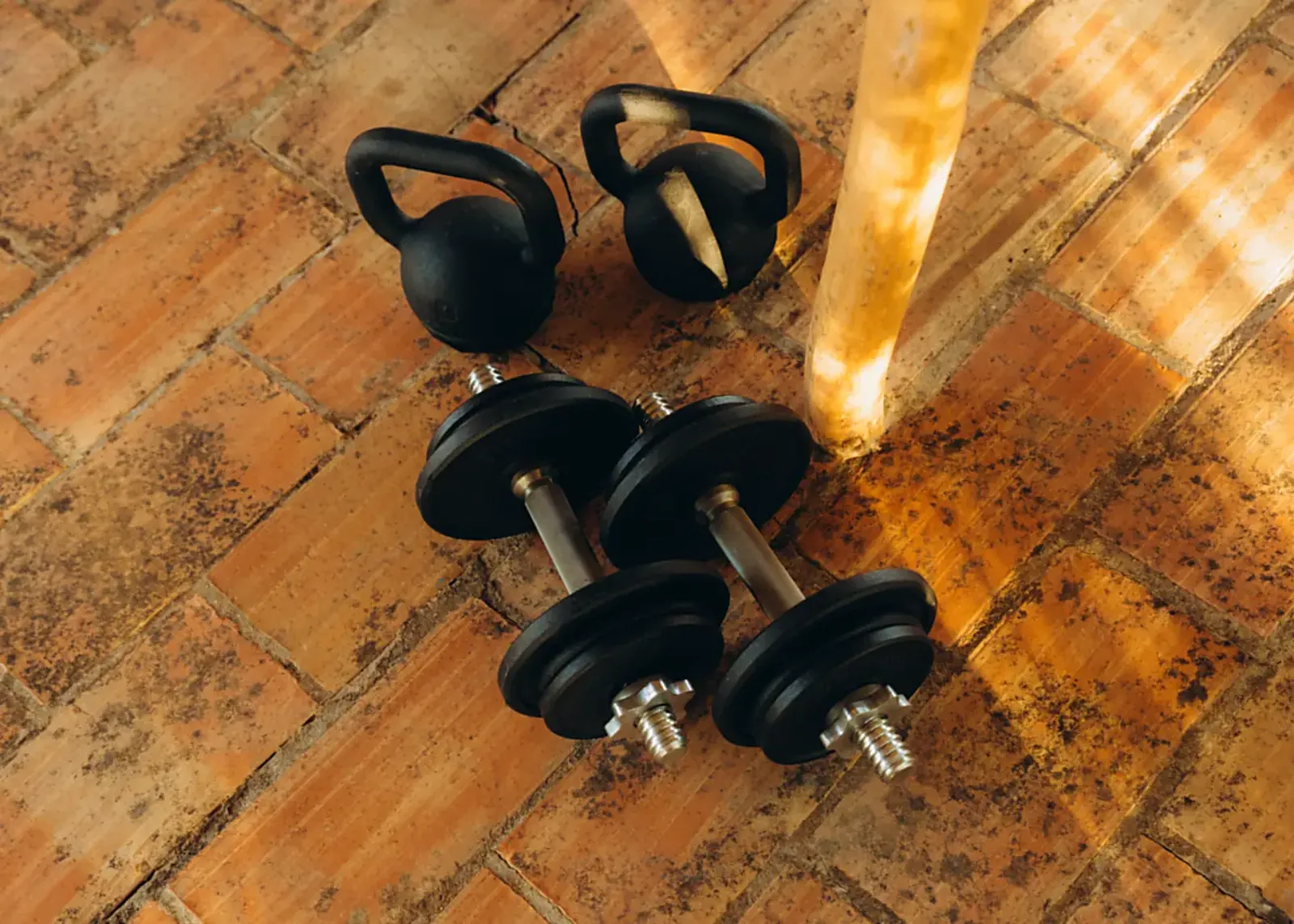
So yes - 2kg is a perfectly good place to start
This is the sentence our co-founder Geraldine Chiu says most often, and it is worth repeating here:
"Building strength is a key to longevity. It's a gradual process based on progressively overloading the weight you lift as your body adapts. For many of our guests, that journey might begin with a 2kg dumbbell. There's absolutely nothing wrong with starting small. Our role is to give them the knowledge, confidence and guidance to build from there."
A 2kg dumbbell that becomes 4kg in six weeks and 8kg by the spring is a training programme. A 12kg dumbbell you pick up once, hurt yourself with, and never touch again is not.
The number you start at is almost irrelevant. The direction of travel is everything.
What happens on the Strength & Fitness retreat
Our programme runs from a minimum of five nights, and it is designed for every level - from guests in their thirties, through menopause, to well past sixty. Most people who book it have never followed a structured strength programme in their lives.
A one-to-one strength and movement session. This is the heart of it. Not a workout to survive, but a teaching session: how to use a gym confidently, and how to perform the four movements everyday life actually asks of you - pushing, pulling, lifting and squatting. Getting off the floor. Carrying shopping up stairs. Lifting a grandchild.
A take-home training plan. Written for your starting point, with the progression built in, so you know what week four looks like before you leave.
Reformer pilates and group fitness, to build control and confidence alongside raw strength.
A guided hike through the Algarve countryside, because strength that never leaves a gym is only half the point.
A health check and nutritional consultation, so you have a real baseline - and because muscle needs protein to build, and most people eat less of it than they think.
All of it in a group of no more than twelve, in a place where nobody is watching, nobody is better than you, and every single person there is figuring it out too.
Explore the Strength & Fitness Retreat →
Post Retreat - what happens when you get home
Here is what we actually want for you, and it is not a retreat habit.
It is that you go home and keep going. For some guests that means walking into a functional training gym without the knot in the stomach, because they now know what a hip hinge is and what good form feels like. For others it means a pair of dumbbells, a resistance band and a mat in the corner of a bedroom, twice a week, for twenty minutes.
Both are strength training. Both work. The NHS lists carrying heavy shopping and heavy gardening as muscle-strengthening activity, which tells you how unfussy this can be.
What they have in common is the thing we teach: knowing what you are doing, and knowing how to make it slightly harder next month.
Shanti-Som Algarve, Opening 1 February 2027
Shanti-Som Algarve opens on 1 February - a nineteenth-century farmhouse and former olive mill in four hectares of orange and almond orchards, twenty-five minutes from Faro. Twenty-two rooms, a gym, a reformer pilates studio, a sauna, an ice bath and a pool.
If you have been meaning to start for a while, and something keeps stopping you, this is a good week to stop meaning to.
Explore the Strength & Fitness Retreat · Check availability · Talk to us
Klaar voor Verandering?
Begin Je Wellness Reis
Ontdek onze persoonlijke retraites in Marbella, ontworpen om lichaam en geest te transformeren.

