
Strength Training for Longevity: Why Weights Matter Most
Cardio and Pilates are good for you. Neither builds the muscle and bone that carries you to eighty. Here's the science, and why 2kg is a fine place to start.
Geraldine
21 October 2026
Most people who decide to get fitter start by moving more. They download a running app, or book the Tuesday Pilates class, or start counting steps.
All of that is worth doing. None of it will stop you losing muscle.
That's the uncomfortable bit, and it explains why strength training for longevity has moved from the edges of fitness culture into the middle of the conversation about ageing well. From your thirties onward your body sheds muscle whether you exercise or not. Harvard Health puts the rate at 3% to 5% per decade after thirty. Bone goes through a similar quiet decline, and gets even less attention. Cardio won't reverse either of them, and neither will a mat class.
What does? Lifting things heavy enough to be hard, then making them slightly heavier.
None of this is about how you look, or about turning into someone who talks about macros at dinner. The question is whether you can still carry your own suitcase at seventy-five, get up off the floor without help at eighty, lift your grandchildren and get back on your feet after a fall rather than having it change your life.
What is Strength Training
First a few definitions-
Strength or resistance training means any exercise where your muscles work against a force. Dumbbells, machines, resistance bands, a loaded backpack, your own bodyweight. Weight training is the version most people picture when they hear the phrase.
Progressive overload is the principle that makes it work. Your body adapts to whatever you ask of it, so the ask has to keep growing: a little more weight, an extra repetition, one more set. Without that creeping increase you maintain what you've got, which is better than nothing but isn't building anything.
Sarcopenia is the clinical name for age-related muscle loss. It isn't a disease you catch; it's closer to a default setting, and resistance training is the main thing known to interrupt it.
What the research shows about Strength Training
Muscle turns out to be a mortality signal
The strongest evidence here has nothing to do with how you look in a swimsuit. A systematic review and meta-analysis in the British Journal of Sports Medicine pooled sixteen prospective cohort studies and found that people who did muscle-strengthening activity had a 15% lower risk of all-cause mortality than people who did none.
Three numbers from that paper are worth noting:
The benefit peaked at roughly 30 to 60 minutes a week. Not hours. Two half-hour sessions.
Risk of cardiovascular disease came out 17% lower, type 2 diabetes 17% lower, total cancer 12% lower.
And people who did muscle-strengthening work alongside aerobic activity had a 40% lower risk of all-cause mortality than people who did neither.
That last figure is the one we'd underline, because it isn't an argument for giving up your runs. They work best together.
Bone responds to load, and to very little else
This is where the comparison with other exercise gets sharp, and it matters most for women.
Oestrogen protects bone, so when oestrogen drops, bone goes with it. The Australasian Menopause Society reports that the average woman loses up to 10% of her bone mass in the first five years after menopause. That's a decade-defining change, and it usually arrives without a single symptom to warn you.
Now the encouraging part. The LIFTMOR randomised controlled trial, published in the Journal of Bone and Mineral Research, recruited 101 postmenopausal women with low bone mass, average age 65. Half of them did supervised high-intensity resistance and impact training twice a week, thirty minutes a session, for eight months. The others did a gentle home programme.
Lumbar spine bone density rose by 2.9% in the training group. In the control group it fell by 1.2%. Femoral neck density held steady in the women who trained and dropped in the women who didn't.
Thirty minutes, twice a week, in women with an average age of 65, and the direction of bone loss reversed. The US National Institute of Arthritis and Musculoskeletal and Skin Diseases explains the mechanism simply enough: resistance exercises "put stress on bones, so they can make bones stronger as well."
Bone responds to being loaded. Not much else has that impact.
What is the optimal weekly exercise routine?
The optimal weekly exercise routine is one that combines strength, cardiovascular fitness, movement and recovery.
Aim for 2–3 strength-training sessions per week to build and maintain muscle, support bone health and preserve strength as you age. Add around 150 minutes of moderate aerobic exercise each week, whether that’s running, brisk walking, cycling or swimming, and aim for 7,000–10,000 steps a day to keep your body moving consistently. Pilates and yoga complement this beautifully by improving core stability, flexibility, balance and body awareness, while swimming offers a low-impact option for cardiovascular fitness. Each type of exercise brings something different, so the goal isn’t to choose one over another but to create a balanced routine.
Keep the activities you enjoy, make strength training a priority, and allow at least one day for proper recovery.
If you find all of the above too difficult to fit into your weekly routine, prioritise strength training and walking. Consistency, progressive challenge and balance are what make a routine effective over the long term.
Starting strength training is less dramatic than you think
The thing that stops people isn't the science. It's the mental image: a loud room full of equipment and people who clearly know what they're doing. It can feel intimidating.
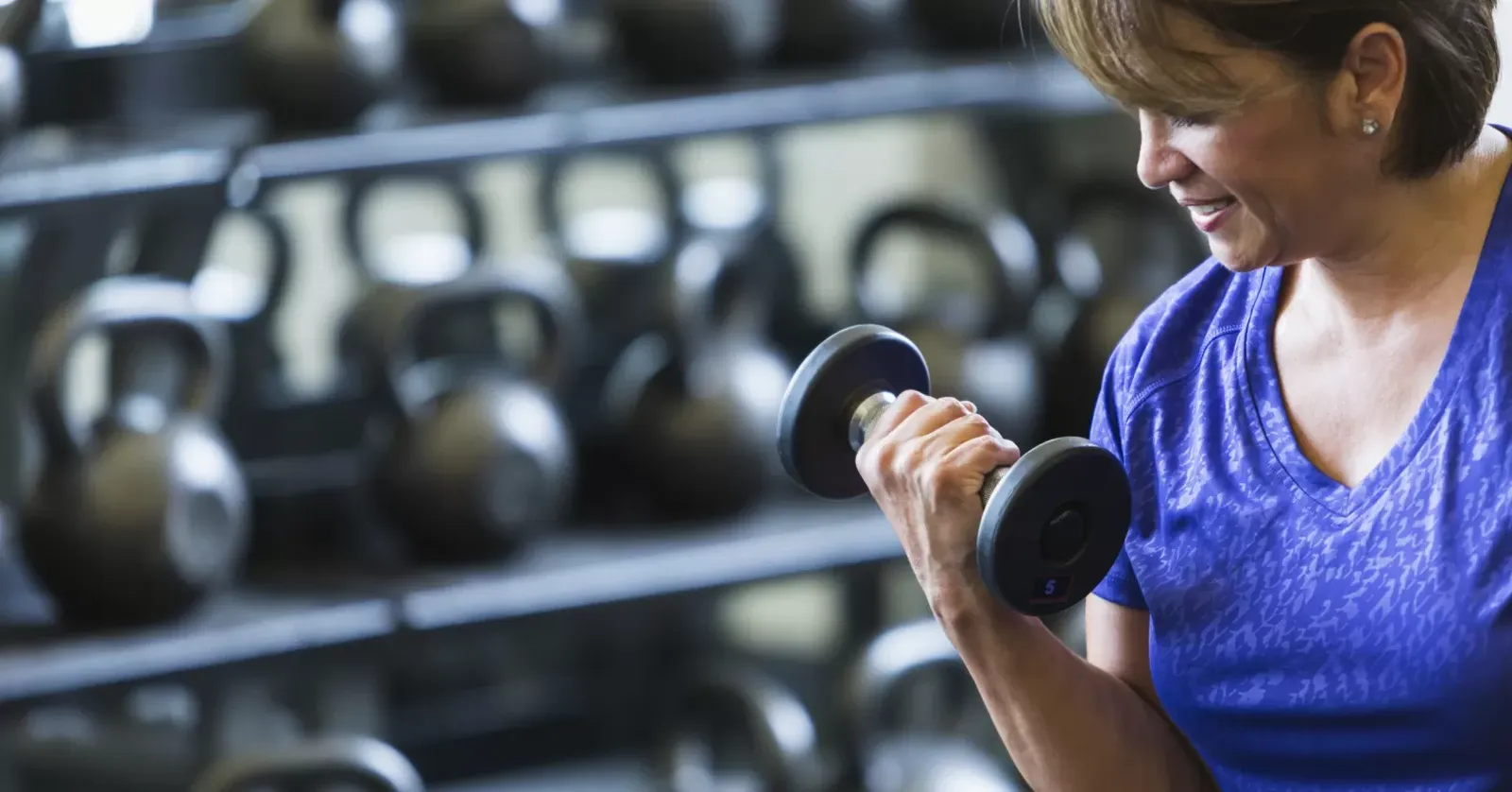
Two kilos is a perfectly good place to begin. So is one. So, for that matter, is a tin of beans, which isn't a joke: the British Heart Foundation suggests water bottles and unopened cans for people starting out at home. What matters isn't the number on the dumbbell. It's that the number goes up.
Here's a workable way in.
1. Train twice a week. The WHO guidelines recommend muscle-strengthening work on two or more days, covering all the major muscle groups.
2. Pick five or six movements that cover the whole body: a squat or sit-to-stand, a hinge, a push, a pull, something overhead, something for the core.
3. Aim for six to eight repetitions of each, moving slowly. Roughly two seconds to lift, two to lower.
4. Progress on repetitions first, then on load. When eight feels manageable with good form, go up to 3kg, then 4kg, then drop back to six reps and climb again.
5. Leave a day between sessions. The adaptation happens during the recovery, not during the workout.
6. Eat enough protein. Harvard Health cites 1 to 1.3g per kilogram of bodyweight daily for older adults doing resistance training, spread across meals rather than loaded into one.
Add half a kilo every few weeks and you'll have added a great deal over a year. That really is the whole method.
If you've got a bone density diagnosis, a cardiac history or a recent injury, get individual guidance before you start.
The retreat we built around strength training
Everything above is why we created our Strength & Fitness Retreat at our Algarve property.
It’s deliberately not a bootcamp. Guests range from their thirties to their seventies, complete beginners train alongside experienced lifters, and many arrive on their own. At the heart of the programme is a one-to-one session with a trainer who helps you refine your technique and develop a personalised plan you can continue at home. The aim is to teach you the fundamentals of strength training, from correct form to progressive overload, so you understand how to build strength safely and effectively. Just as importantly, it’s about building confidence and breaking down the barriers that can make the gym feel intimidating. You don’t need to be experienced or fit to get started. We want you to leave feeling confident in your ability to build strength and live without unnecessary physical limitations — whether that means bending down, picking something up, squatting or simply moving through everyday life with greater ease. The goal is for you to leave knowing what to do, how to do it, and feeling confident enough to keep going long after your retreat ends.
Around that sit the other four pillars, in a week that's structured rather than crammed. Morning yoga. Food built for recovery. A guided hike through the countryside in the afternoon. Breathwork and meditation on the rooftop before dinner. Sauna, steam room, ice bath, and enough space between sessions for your body to get on with its repairs. You tell us how you're feeling each morning and the session flexes to match.
No special equipment. No supplements. Nothing you can't carry on doing in a quiet corner at home with a pair of dumbbells.
If strength isn't your entry point, our broader fitness programme and yoga retreat come at the same five pillars from a different direction, and you can compare everything we run side by side.
What we wanted to avoid was a week that feels transformative and then evaporates on the flight home. The point is to send you back knowing how to lift, what to progress, and why it's worth the twenty-five minutes each day.
Strength is one of the very few things you can still be building at seventy. Start light, keep going, and let the years do the compounding.
Frequently asked questions
Is it too late to start strength training at 60 or 70?
No. The women in the LIFTMOR trial had an average age of 65 and low bone mass when they began, and they improved their spine bone density over eight months. Harvard Health describes progressive resistance training as the best way to build muscle at any age. Starting later means starting carefully, ideally with supervision, but it doesn't mean starting pointlessly.
How heavy should I lift as a beginner?
Light enough that your form holds for eight repetitions, heavy enough that the last two or three are genuinely hard. The weight itself matters far less than whether it increases over the months.
Is weight training better than cardio?
They do different jobs, and the research suggests you want both. The BJSM meta-analysis found the lowest mortality risk in people doing muscle-strengthening work and aerobic activity, a 40% reduction compared with people doing neither. If you only do cardio you have a gap. If you only lift you have a different one.
Will lifting weights make me bulky?
Building substantial muscle mass takes years of dedicated training, a lot of food and usually favourable genetics. What most people notice in the first year is that they look more defined, stand up straighter and find stairs easier.
How long before I see results?
Strength improves within two to four weeks, mostly through better neural recruitment before anything visible changes. Muscle size follows over two to three months. Bone is slowest of all; LIFTMOR measured its changes at eight months. This is a practice rather than a programme with an end date.
Ready to Transform?
Start Your Wellness Journey
Discover our personalised retreats in Marbella, designed to transform body and mind.

